 HighTempPressure
Water-Cooled Dynamic Pressure Sensors
Keep the sensing element separated from the heat load while measuring combustion pressure and fast pulsations. Define the thermal exposure and the measurement chain together.
800–1,500°C+ hot-gas projects · configuration-specific review
HTP-WC1000 identifies an RFQ configuration family. Final ratings and an issued drawing are agreed for the selected build.
Explore HTP-WC1000 ↗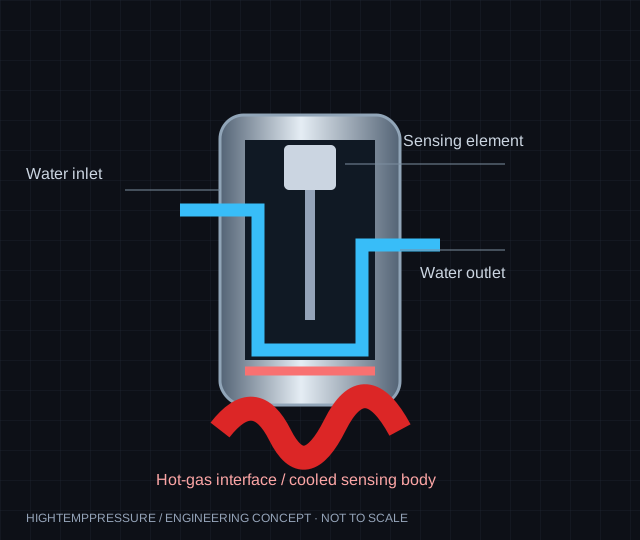
HTP-WC1000: conditions that determine the configuration
Normal and peak pressure; gauge, absolute or dynamic reference
Gas temperature, exposure duration, heat flux and cooled-body limits
Coolant conditions and shutdown behavior
Flushness, seat seal, installation torque and dimensional drawing
Define hot-gas exposure and the cooling boundary
Requests may include 20–200 kHz useful bandwidth, 50–300 kHz natural resonance, ranges from 0–1 to 0–100 MPa, or transient gas exposure toward 2,000°C. These are separate engineering inputs, not a combined available rating. Confirm coolant-jacket pressure, cleanliness, chemistry and heat load. Review leakage consequences for the medium and define cooling during startup, heat exposure and post-shutdown heat soak.
Two pressure technologies, different signals
A cooled piezoresistive bridge can support static and dynamic measurements when its specification permits. A charge-mode piezoelectric probe measures changing pressure and requires a matched charge amplifier; it does not retain a true DC pressure reading indefinitely.
Cooling is part of the measurement system
Specify coolant inlet temperature, flow, pressure and chemistry, outlet routing and available heat rejection. Establish flow before heat exposure and use a low-flow interlock suited to the test stand. Hose ratings apply at the hose location, not at the combustion-gas temperature.
Flat response before headline resonance
State the required flat amplitude and phase response, not just natural frequency. A request for 20–200 kHz needs the probe, mounting cavity, conditioner, cable and anti-aliasing DAQ reviewed as one chain. A 100 kHz resonance is not a 100 kHz flat bandwidth.
Where HTP-WC1000 fits the pressure duty
Rocket propulsion tests, scramjet combustion development, cylinder knock research and gas-turbine thermoacoustics.
Bridge mV/V or charge output; matched wideband conditioning
Request configuration evidence →Accessories selected around the sensing technology
For bridge-output probes only. State the required DC–100/200 kHz target, excitation, cable and BNC output; final bandwidth and price require review.
For charge-mode probes only. Confirm pC range, low-frequency cutoff and upper bandwidth.
Confirm coolant pressure, local hose temperature and fitting/seat dimensions.
Budget reference only; active refrigeration, heat rejection and pump capacity require a separately confirmed configuration and price.
USD budget references. Final selection and commercial prices follow the reviewed RFQ.
Before specifying HTP-WC1000
Does the temperature band guarantee a supplied rating?
No. It describes an application selection route. Media, sensor-body, cable and electronics limits must be confirmed from the selected configuration documentation.
Can this replace an existing branded sensor?
Send the complete part number, installation drawing and electrical specification. Thread size alone does not establish equivalence in sealing, insertion depth, signal behavior or dynamic response.
What documentation should accompany the quotation?
Request a configuration datasheet, dimensioned installation drawing, wiring details, calibration scope and the evidence relevant to thermal duty and response.
Turn your thermal duty into a clear sensor RFQ.
Send media and ambient temperatures, pressure reference, dynamics and mounting requirements.
Request an engineering quote ↗