 HighTempPressure
Industrial High-Temperature Pressure Transmitters
Separate hot steam, thermal oil or process fluid from the transmitter electronics with a suitable cooling-fin tower, standoff or isolation arrangement.
200–450°C process targets · configuration-specific review
HTP-FIN identifies an RFQ configuration family. Final ratings and an issued drawing are agreed for the selected build.
Explore HTP-FIN ↗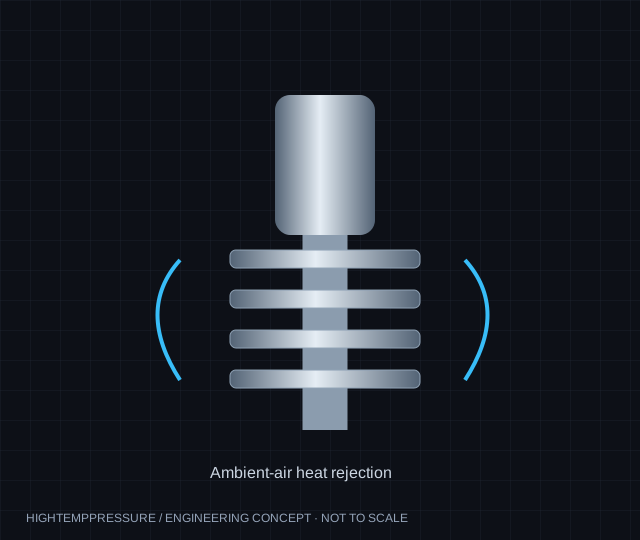
HTP-FIN: conditions that determine the configuration
Continuous and cleaning-cycle temperatures, ambient and installation orientation
Wetted alloy, corrosion compatibility and diaphragm style
Pressure range, overload, loop supply and load
CIP/SIP duration, sanitary seal and finish where relevant
Choose the sensing element and isolation arrangement
Sputtered thin-film and silicon-on-sapphire are possible sensing routes. Heavy fuel oil and 150–200°C CIP/SIP duties need their own material, seal and cycle review. A remote seal also needs fill-fluid and vacuum/temperature compatibility checks. Do not assume a 350°C process will produce electronics below 65°C without installation-specific evidence.
Media temperature and ambient are separate limits
A cooling tower rejects heat to its surroundings. Its performance depends on airflow, insulation, orientation, ambient temperature and exposure time. A 350°C process does not by itself prove a safe electronics temperature.
Match the output to the receiving channel
Request 2-wire 4–20 mA, 0–10 V or the required supply and wiring arrangement. HART and RS485 Modbus are model-dependent requests. Include loop load, response time, connector and cable-temperature requirements.
Steam siphons change the pressure path
A properly filled steam siphon can reduce heat transfer and protect the instrument. Its effect depends on installation and operating conditions; no fixed temperature drop applies everywhere. Condensate columns, isolation volumes and remote capillaries can add offset, lag or resonance.
Where HTP-FIN fits the pressure duty
Superheated steam, thermal-oil heaters, hot hydraulics, geothermal process skids and autoclave monitoring.
4–20 mA / 0–10 V; optional protocols by selected configuration
Request configuration evidence →Accessories selected around the sensing technology
Request M20×1.5, G1/2 or 1/2 NPT as applicable; review pressure and temperature derating.
USD budget references. Final selection and commercial prices follow the reviewed RFQ.
Before specifying HTP-FIN
Does the temperature band guarantee a supplied rating?
No. It describes an application selection route. Media, sensor-body, cable and electronics limits must be confirmed from the selected configuration documentation.
Can this replace an existing branded sensor?
Send the complete part number, installation drawing and electrical specification. Thread size alone does not establish equivalence in sealing, insertion depth, signal behavior or dynamic response.
What documentation should accompany the quotation?
Request a configuration datasheet, dimensioned installation drawing, wiring details, calibration scope and the evidence relevant to thermal duty and response.
Turn your thermal duty into a clear sensor RFQ.
Send media and ambient temperatures, pressure reference, dynamics and mounting requirements.
Request an engineering quote ↗