 HighTempPressure
HTP-DYN — Dry High-Temperature Dynamic Pressure Sensors
Discuss a dry sensing head with remote electronics when cooling services are unavailable. Select the sensing technology from the real temperature and low-frequency requirements.
450–700°C application review · configuration-specific review
HTP-DYN identifies an RFQ configuration family. Final ratings and an issued drawing are agreed for the selected build.
Configure your RFQ ↗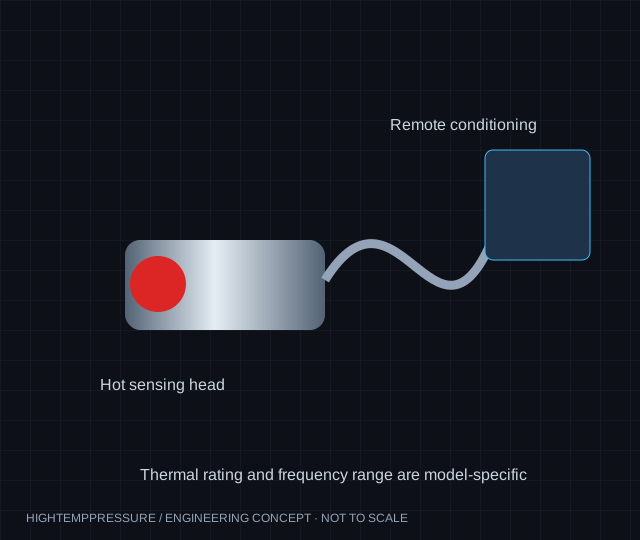
HTP-DYN: conditions that determine the configuration
Head temperature and dwell time; ambient at the conditioner
Lowest and highest useful frequency with allowed amplitude error
Dynamic amplitude plus total static line pressure
Connector insulation, cable length and mounting cavity
Set dry-head temperature and cable limits separately
A high-temperature charge pressure sensor needs a matched charge amplifier and a stated low-frequency cutoff. Include insulation, connector temperature, cable length and total pressure as well as dynamic amplitude.
Turn the family into an orderable configuration.
Start with the pressure range and reference, then define the output and excitation. Specify the connection, seat seal, diaphragm position and available envelope from the installation drawing. Media temperature, electronics ambient and exposure time are separate requirements.
For this dry family, provide the lowest and highest useful frequency, the head/cable temperature profile and total line pressure in addition to pulsation amplitude.
What the reviewed quotation should identify
Selected configuration code and ratings; issued dimensional and wiring drawings; calibration scope; agreed accessory part numbers; documentation and acceptance requirements; final price and delivery terms. Custom thermal or frequency requests require available evidence to be reviewed before order confirmation.
Where HTP-DYN fits the pressure duty
Turbine combustion monitoring, exhaust pulsation and hot research instrumentation where coolant is unavailable.
Charge or remote bridge conditioning; technology selected per duty
Request configuration evidence →Accessories selected around the sensing technology
For bridge-output probes only. State the required DC–100/200 kHz target, excitation, cable and BNC output; final bandwidth and price require review.
For charge-mode probes only. Confirm pC range, low-frequency cutoff and upper bandwidth.
USD budget references. Final selection and commercial prices follow the reviewed RFQ.
Before specifying HTP-DYN
Does the temperature band guarantee a supplied rating?
No. It describes an application selection route. Media, sensor-body, cable and electronics limits must be confirmed from the selected configuration documentation.
Can this replace an existing branded sensor?
Send the complete part number, installation drawing and electrical specification. Thread size alone does not establish equivalence in sealing, insertion depth, signal behavior or dynamic response.
What documentation should accompany the quotation?
Request a configuration datasheet, dimensioned installation drawing, wiring details, calibration scope and the evidence relevant to thermal duty and response.